Christa Anchovy
Some inheritances come with a fishing rod attached

This September, I’m going to Ischia to fish — not for a photo, but to learn how it’s actually done, old ways or new, nets or rods, hands on the same water my blood came from.
I think the first fish I ever caught was a sunny, out of some freshwater pond in Pennsylvania — there was nothing overly memorable or dramatic about it, nothing noteworthy to save for the ages. The real fishing, the fishing I loved most, the fishing that was sacrosanct, happened with my father at the south Jersey shore off the coast of Sea Isle City.
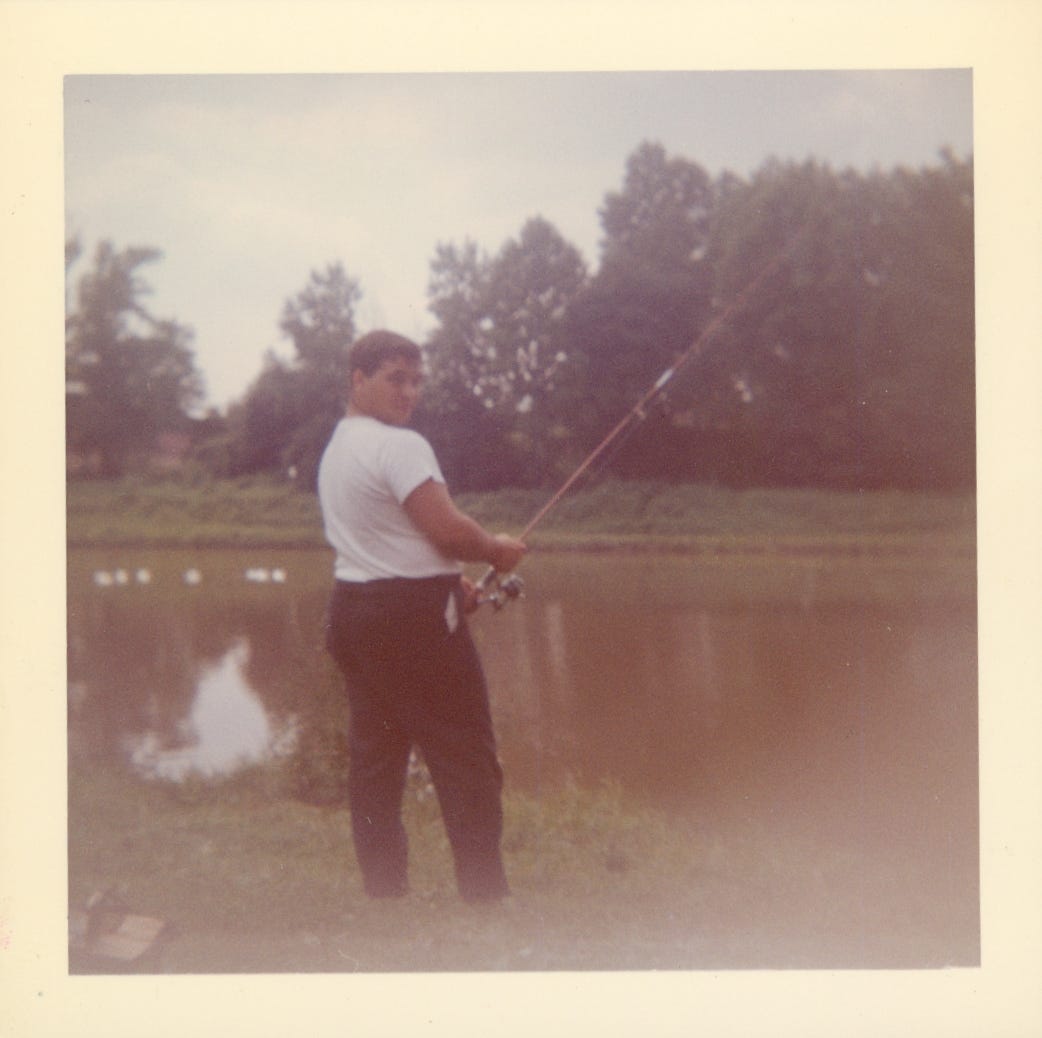
PHOTO: Dad, young, fishing at the pond — Labor Day 1962
Dad would load up whichever of his kids were willing that day, which was usually all of us, and off we’d go. I can still smell those shore-town childhood memories — the wet sand, salty air, melted salt water taffys, and the squid we used for bait — a smell that only got riper as brutally hot summer days wore on.
We didn’t own a boat, a beach house, or a dock, but we still managed to fish in various places without the financial wealth or trappings of such things. As Dr. Seussish as it is, it happened just like this: We fished off the sand, off rocks, off docks, with rods, with nets and with crab traps baited with chicken legs. We fished early in the morning, at mid-day, and sunset — whenever we had the chance, we were there. Here fishy fishy fish! My father would also take us out on half-day fishing “party boats” — a real thing here in America, for any of my Italian friends reading this who’ve never heard the term. We pay to go on a fishing boat, rent rods if we need them, and groups of families and strangers are led into the waters of southern New Jersey to find fish and reel them in. My father patiently tried to teach me how to untangle fishing line, to set the reel, to cast, to release the reel into the water, to reel in a fish (if I got so lucky), and how to bait a hook, which is significantly easier with something already dead, like squid, than something very much alive, like a worm. I still get girlie squeamish when baiting a worm. Some things never change.
The sea was in my father’s DNA, and he never made apologies for it, nor should he have. Dad always dreamed of living by the ocean — enjoying stunning views of the water from whatever angle it presented itself. It makes me a bit sad he never was afforded the opportunity to do so. He surrounded himself with the color blue, especially in his home office. He collected various blue glass and tchotchkes, wooden fishing boats, and trinkets of various sorts, bringing his love of the ocean into the bowels of suburban life.
My father worked hard for his family, who he loved above everything else, more than pasta, more than sfogliatella, more than the sea. Dad made sure his brood of offspring had the opportunity to spend time at the shore, even if only one week a year. As a kid, I knew money was tight. I also knew a lot of things a young child often doesn’t, often shouldn’t, and I observed everything with a keen eye and deep emotion. This has been a curse and a blessing.
Whatever we caught, we ate — unless it was too small, in which case back it went. It wasn’t until I was older that I learned some people fished only for sport and threw everything back regardless of size. Sport fishing? This made absolutely no sense to me, and to be honest, I looked at those throwing perfectly edible fish back with derision — so much so I find myself saying “merigan” as I write this. Why fish if you have no intention of eating what you catch? I understand now why it made no sense: I come from a line of people who never fished for sport. They fished to survive.
— — —
My father once wrote to me about our people, the Ischian side, who lived at the Jersey shore, in an email I’ve kept:
“We went to Ocean City NJ. My grandmother’s family lived there. Her two sisters lived in adjacent houses. Zia Madalena and her husband, Bartolomeo, and next door were Zia Theresa (Terozina) with her husband, Gennaro, and three sons. The food never stopped coming and the vino bottle was kept full at all times... Nothing but full bellies and laughter. Why can’t we go home again?”
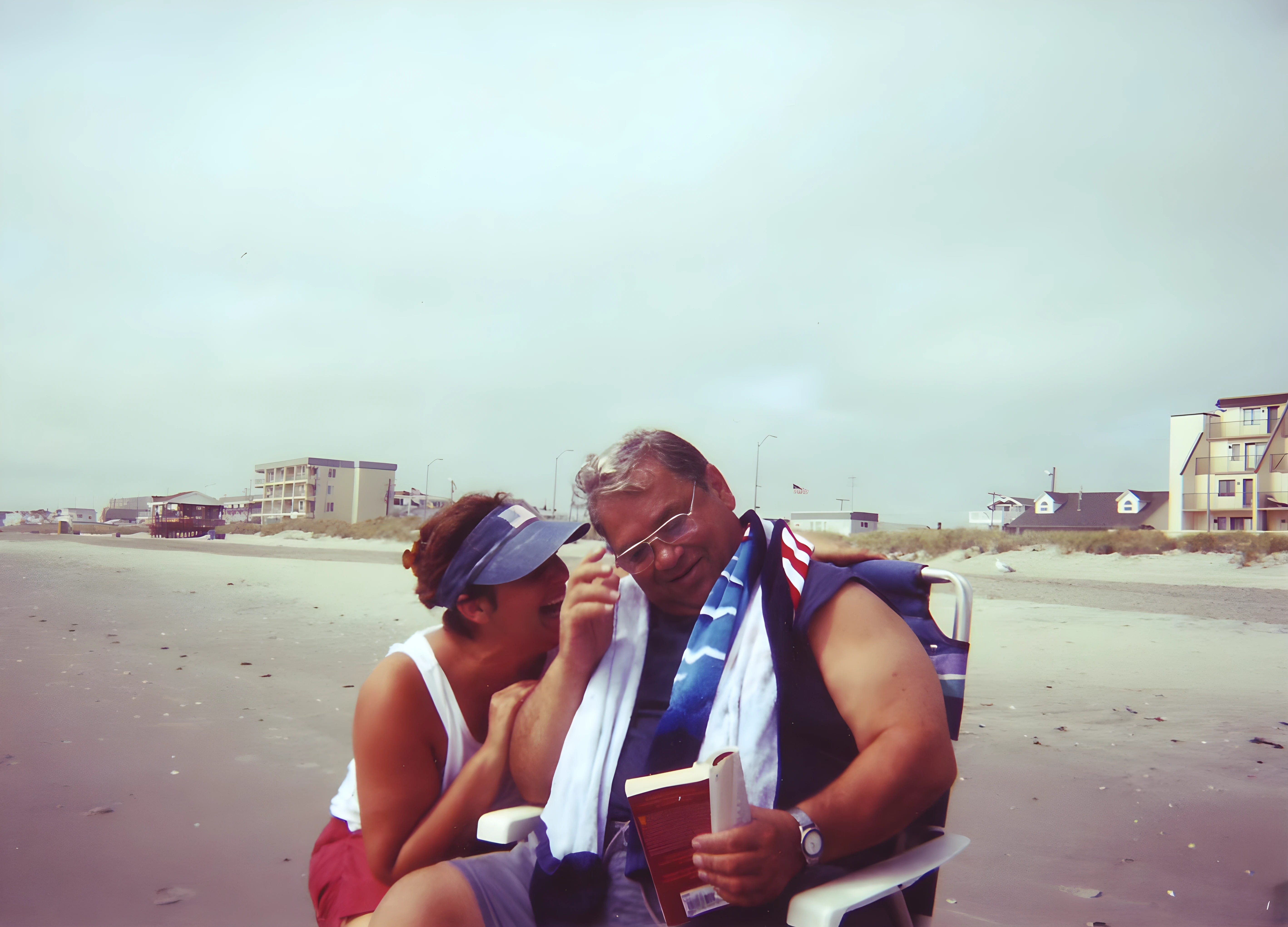
PHOTO: Christa and Dad, Sea Isle — our favorite photo
Exactly, Pop. Why can’t we go home again?
That question has been ruminating inside my mind for years — so much so that I felt compelled to move for Italian citizenship, in part, to test the theory myself. I knew if anyone was going to go back, it would be me.
Home, my father believed to the end, was wherever his family was — the whole loud, obnoxious, opinionated lot of us, at one table, together. That’s what Ocean City meant to him, and that’s most of what “why can’t we go home again” was really asking. It’s hard to write the next part, but this piece would be a lie if I left it out: the family he loved fiercely is shattered now, likely for good. But I’m Catholic, and hope isn’t optional for me; it’s doctrine. The same hope that tells me a man rose from an actual, sealed, guarded tomb tells me nothing is ever permanently beyond repair, even things I have no real expectation of living to see mended myself. That’s not yearning. That’s just what hope is supposed to feel like — steady, a little stubborn, and entirely separate from wanting. Going back to Ischia was never really about resurrecting what’s broken here at home. What we go back for is the good that was real once: the love, the culture, the full table before it emptied out. That’s still worth chasing, even after the reason for chasing it changed shape.
— — —
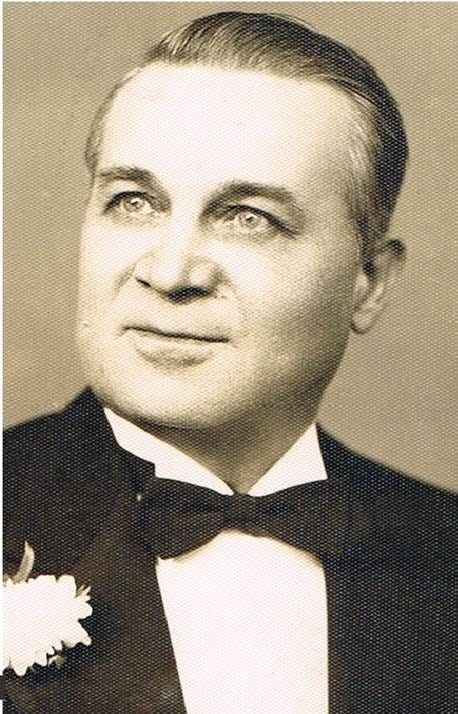
PHOTO: Francesco Iacono, portrait
The fishing gene goes back further than the Jersey shore. My great-grandfather Francesco Iacono — Frank, once he got here — traded a beautiful, difficult island and a life of fishing for the uncertain hope that his descendants might have it easier than he did. Fishing off Ischia wasn’t a hobby, or a Saturday, or a thing you did for the joy of it. It was brutal, uncertain work in small open boats against a sea that owed you nothing back and took plenty of men who trusted it anyway. So Francesco did the thing that must have felt like the safest, smartest bet a young man without great means from Ischia could make: he left the water for machinery. Got a job as a crane operator at the Baldwin Locomotive plant in Chester, Pennsylvania. Steady wage. Solid ground. No storms.
In 1948, the machinery killed him. He was sixty-three.
You cannot write that sentence and not be struck, in the worst possible way, by the cruel humor of that fate. Of course the man who spent his whole life outrunning the sea’s danger got cut down by a crane instead, on dry land, in a paycheck job, doing everything right. There is nothing more Italian than a story where the universe sets up a joke that isn’t funny and dares you to laugh anyway. Dark humor and tragedy. My people do that well.
His daughter Tressa (Teresa) — my grandmother — had been born in Chester in 1907, was taken back to Ischia as a small child, and returned to America around 1921. So the crossing of the sea happened twice in one family before I was ever born: the island to America, then briefly, strangely, back to the island, then America again, like the Atlantic couldn’t decide which side of it we belonged on. I’m still not sure it has. And I’m still not sure where I belong.
— — —
In October of 2018, my father and I were texting about the Mega Millions jackpot — 1.6 billion dollars, “Holy shit,” in his words. He’d just bought the tickets, Powerball and Mega Millions both, and he sent me a voice memo from his car to make sure I understood the stakes: when we hit them, he said, we were building our own Castello Scalise on the beach in Forio. Not a house. A castle. His, with our name on it, planted right on the Ischian coastline like we’d always belonged there and just needed the cash to prove it. If you’re gonna dream, dream BIG, baby!
I told him, half-joking, that the first thing we’d buy with our winnings was a houseboat. Fishing every day. Not sixty seconds later, in that very same conversation, I asked him something that had nothing to do with lottery numbers at all: did he know why Francesco went back to Italy after his mother Tressa was born? My friends and I were on a ferry back to Naples when I texted him that question. He didn’t know. Nobody in the family ever really knew. And there’s no one left to ask.
But there we both were — the fantasy of endless fishing and the actual, unanswered question about our fisherman ancestor, sitting one text bubble apart on the same screen, like my thumbs understood something my brain hadn’t caught up to yet. That’s not a coincidence, or if it is, it’s the kind I’ve stopped believing in as just coincidence. That’s DNA talking before you’ve given it permission to. That’s my ancestors tapping on my shoulder saying, follow us.
Two months later, the night before he went in for surgery, the jokes went quiet for a second and something truer slipped through. He texted me at 9:38 on Christmas Eve: “Even if I don’t win the $321 million mega millions tomorrow I’ll still have you. That’s riches enough.” And then, because he could not leave sincerity sitting out in the open for long, he covered it immediately: “Of course if I do win we can all tell the world ‘we’ve got two words for you world and they ain’t Happy Motoring.’” That was my father in two sentences — soft enough to tell me I was worth more than 321 million dollars, and quick enough to undercut his own tenderness with a punchline before either of us had to sit with it too long. Funniest man I ever met.
— — —
I never got to ask Francesco anything. I never got to ask my father everything, either — there wasn’t time, in the end, for all the questions I didn’t know yet that I’d want answered.
But here’s a thing my father and I did get to do, over and over, in the last stretch: we talked and joked about heaven. Not in the vague, syrupy greeting-card way people mean it when they say “he’s in a better place” — an actual, specific, ongoing comedy bit between the two of us. We’d talk about how in heaven we wouldn’t need food, and wasn’t that going to be a waste, so obviously God would let us eat anyway, whatever we wanted, no cholesterol, no guilt, no doctor wagging a finger. And we’d talk about all the relatives we’d finally get to meet or see again — Francesco, Regina, Tressa, every great-aunt and second cousin who died before I could ask them a single question — and how we’d finally get the answers to the genealogy questions we’d spent a decade chasing through courthouses and archives and cold emails to strangers. Heaven, to us, was a family reunion with a full table and no gaps left in the record.
Near the end, when Dad knew what was coming, the joke got quieter and more true at the same time. He stopped talking about food. He told me, plainly, that he just wanted to see his parents and his siblings again. That was it. That was the whole want.
I believe he has. I believe that’s where he went home to — not Ischia, not Chester, not the south Philly pool hall where he grew up, not a set or a soundstage, and not the shore. The place where the record is already complete, where every question we ever chased through a state archive gets answered without a fee, a form, or a three-year wait. My faith tells me he’s sitting at that table right now, plate piled absurdly high, next to relatives he never met, finally getting the answers I couldn’t find for him in time. Finally getting all the love he deserves for eternity.
I’ll say the rest of it plainly, because burying the most important part in a footnote would be its own kind of dishonesty: I believe our real home isn’t Ischia, and it isn’t Chester, and it isn’t even that Jersey shore table with the wine that never ran dry. Our home is heaven, punto e basta. Or it’s hell, punto e basta. And we get a say in which one, every single day, in how we live. I’m not going to stand at your door in a black suit with a pamphlet and ask if you’ve accepted Jesus Christ as your personal Lord and Savior. But I will say this much: Jesus was a fisher of men, which is, when you think about it, the only kind of fishing that has ever actually mattered. So when I finally get in that boat off Ischia, chasing anchovies or who knows what else with some kind stranger who offered to help a woman he’s never met catch a lifelong dream because she asked into the void on Facebook, I’ll have all of it in my chest at once — Francesco, Dad, the fish, and the much bigger thing underneath the fish, which is that all of us, every single one, are just trying to find our way home.
— — —
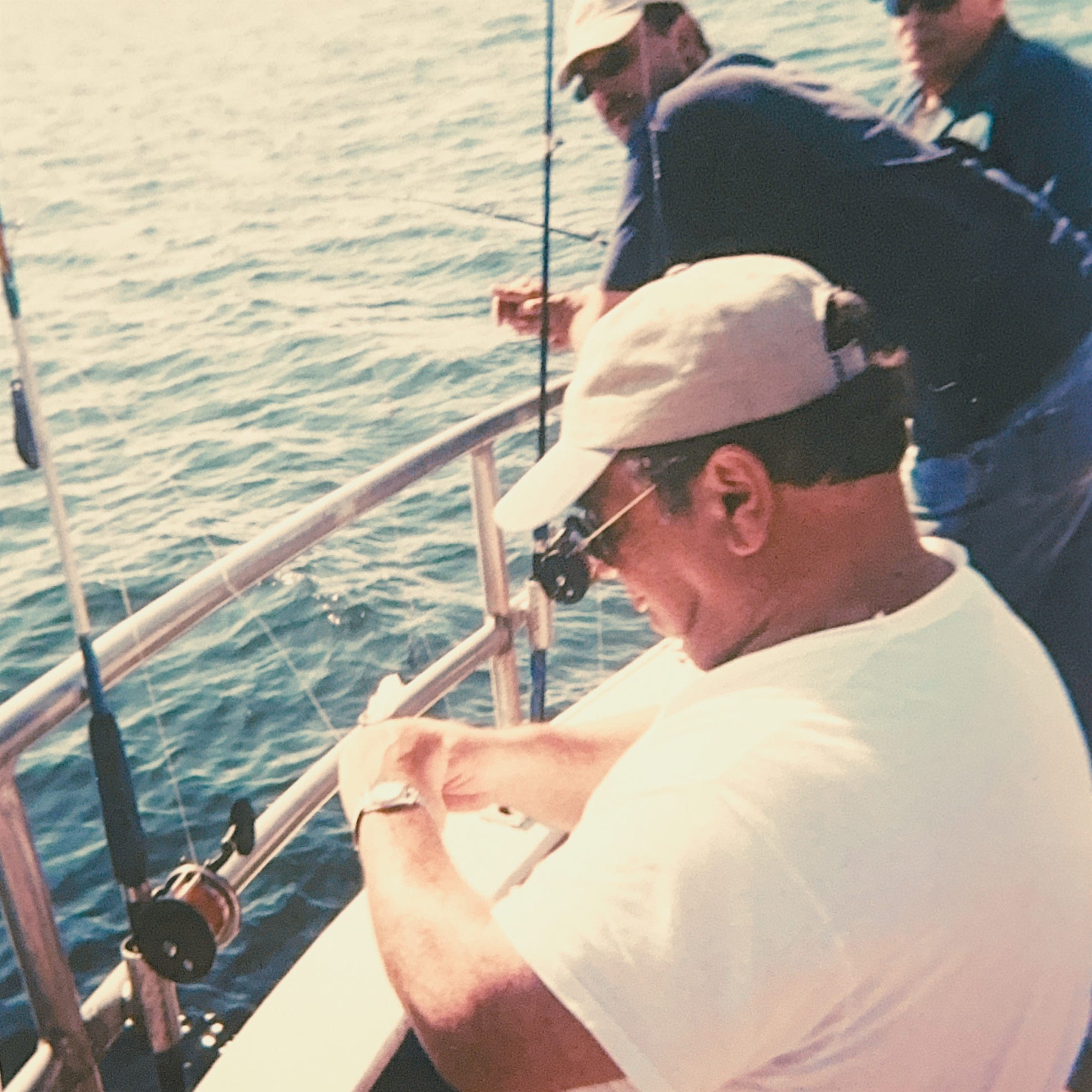
PHOTO: Dad on a party boat, fishing off south Jersey
This September, I’m going back to the island Francesco left — not to fish for survival, nobody in my family has needed to do that in a hundred years, but to actually put my hands on it. I haven’t been asked to pull a net yet; the offers I’ve gotten so far are simpler than that — a rod, a shoreline, someone patient enough to show me how it’s done. I’ll take it. I want to learn however it’s still taught there, old way or new, nets or rods. I just want someone to hand me the line and let me feel what four generations of my family felt before me.
A friend of mine calls me Christa Anchovy, and once you know how I actually live, it stops sounding like a bit and starts sounding like an accurate job description. Say “Christa Ann” fast enough and “chovy” is just the next logical syllable. I have espresso cups from Ischia Ponte with little anchovies painted on them. I bought my father a blue mug there with an anchovy on it, and it’s mine now, sitting on my bathroom vanity. When I dabbled in ceramics for a hot minute, I made a small salt dish with an anchovy pressed into the clay. A friend of mine, gone now too, once took me to a ceramic shop in Forio, where I bought a big blue vase with an anchovy on it that I still look at every day. So the nickname isn’t really a joke invented out of nowhere — it’s just true. My middle name is Ann — Christa Ann — and somewhere along the way “Christa Anchovy” replaced it, and honestly, it fits better.
I love anchovies fried, and Dad was right there with me on that. The first time I ate them that way in Ischia, I sent him a photo with a caption that only makes sense if you knew my father: Pop, that was so good, so satisfying, I’d light a cigarette if only I smoked them. He got the joke instantly and wrote back: “You’re so sick, Christa. Warped. Never change. Never ever change.”
I won’t, Pop. I won’t.
Because that’s what this actually is, when I strip away the sentiment: an inheritance test. Francesco fished to survive. Then he traded the sea for a crane and still didn’t outrun it. My father dreamed of an ocean view he never got and taught his kids to bait a hook with dead squid on borrowed afternoons at the shore. And now here I am, decades and an ocean away from where it started, about to fish off the same coastline my blood came from — not because I need the fish, but because some things aren’t optional no matter how many generations and how much geography you put between yourself and them. That’s not nostalgia. That’s DNA, doing what DNA does, whether you go looking for it or not.
I don’t know yet exactly how it will happen. I don’t know who will take me out, or when, or whether the sea will cooperate. But I’m not waiting to see what the island decides to give me. I’m going to go get what’s already mine.
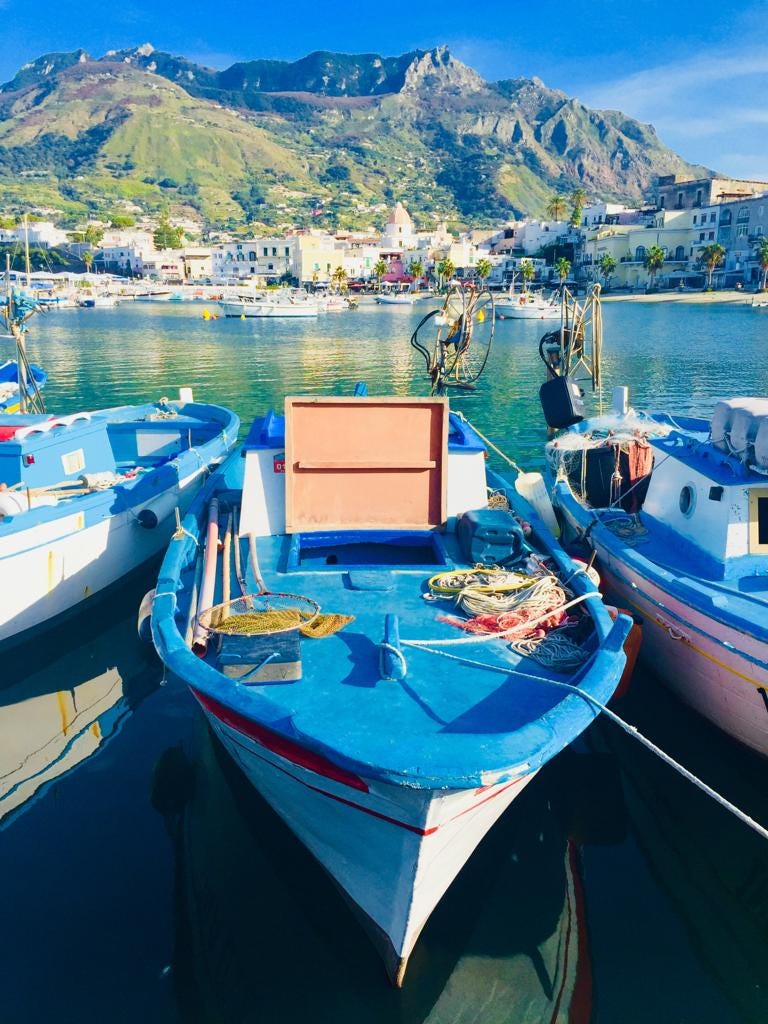
PHOTO: Boats, Forio centro in background
I feel the peace in your heart.