La Figlia Ischitana
The Ischian Daughter

I never expected a bunch of old stone fences to stop me cold. But the first time I drove around Ischia, there they were—and something in me recognized them. Like a hand on my shoulder from beyond time.
It was very late August 2015. I was in the backseat of my friends’ car, emotions running high, heart bursting with gratitude just to be there—to travel, to search, to discover. I felt this strange, almost overwhelming sense of coming home to a place I’d never actually been. At the same time, I kept thinking: I haven’t earned this. I don’t know if I even deserve to feel this way.
The road curved and suddenly they appeared—low walls of dark volcanic rock snaking through the terraced vineyards, holding the soil and the history in place. Everything in me went quiet, and yet internally I was buzzing with a kind of excitement I can’t describe. It was more than déjà vu. I knew I’d never set foot on that island before, yet it felt impossibly familiar. Something clicked deep inside, even if I couldn’t name it at the time. Ten years later, that moment still lives in me. Those stone fences were waiting for me long before I arrived. Without realizing it, they had already been imprinted on me before my birth. Some things you carry in your blood so long they stop feeling like stories you were told and start feeling like memories you lived.
— — —
My great-grandmother Regina Foglia was born in Panza in 1884. Her mother was a Migliaccio. Her father Francesco was born there in 1853, built his life in those terraced hills, and then left in the early 1900s and died in Philadelphia in 1922. Our research shows that when Francesco left, our Foglia line on Ischia ended with him. The name disappeared from this island the day he boarded that ship.
Except it didn’t disappear from the walls.
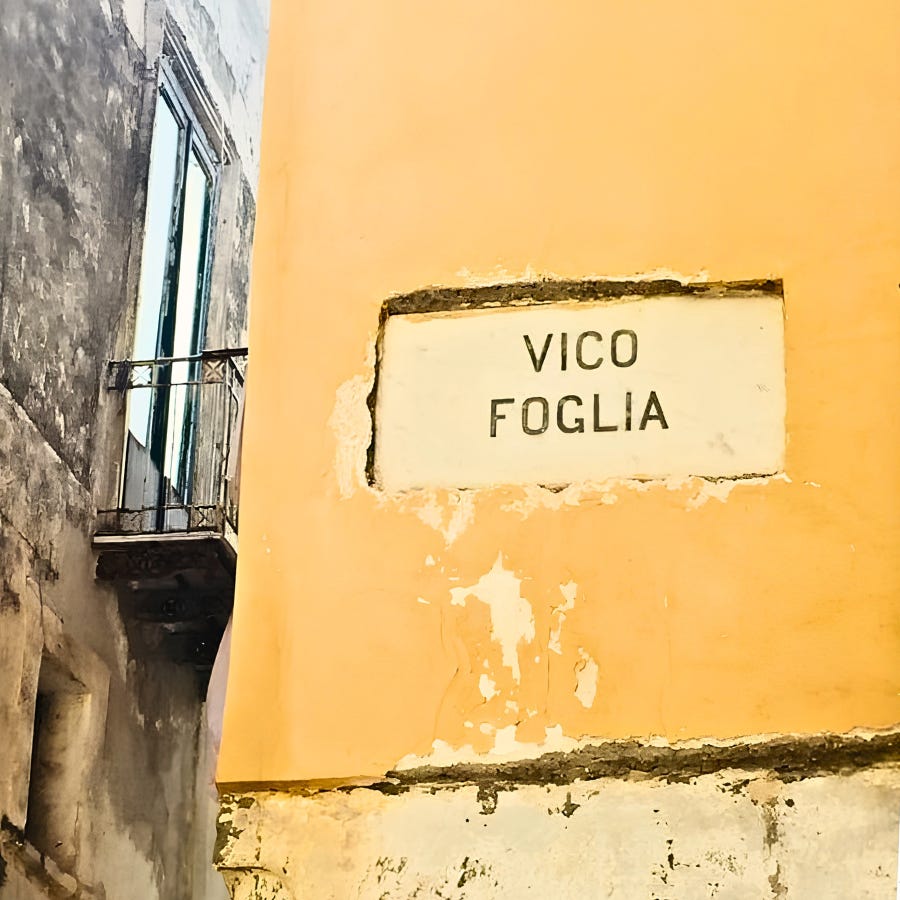
In October 2018, walking the back streets of Forio with a friend, I turned a corner, looked up and stopped cold. On the ochre wall ahead of me was a small ceramic street sign that read: Vico Foglia. My great-grandmother’s name, right there, sun-faded and slightly crumbling, still on the wall of her town a hundred years after the last Foglia left.
I could not speak. Tears started welling up. I grabbed my phone to take a photo to send to my dad, my hands shaking a little. It felt like my ancestors saw me, noticed me — as though finding that vico was their ciao figlia mia and their invitation to keep going.
I did.
My father was Charles Joseph Scalies Jr. Born July 19, 1940 in Philadelphia. Died May 1, 2025. He wrote a screenplay once — a love story set in the pool hall his parents ran in South Philadelphia in the 1950s — and the narrator opens it this way: Life is like shooting pool. When you run out of balls, the game is over. That was Pop. He could say the truest things sideways, through a joke, with a straight face, and then laugh before you could catch up. He was the funniest person I have ever known, and he was also, without qualification, the most loving. He called me his joy. He called me figlia mia. He was my co-pilot, my audience, my north star, and the reason any of this happened at all.
This story belongs to him as much as it belongs to me.
— — —
This whole journey to Ischia started, as many of the best stories do, with total strangers and an idea that probably sounded absolutely crazy.
I was in Assisi during a brutally hot summer in 2015, grinding through beginner Italian language classes and trying to learn as much as I could. I’d come to Italy to immerse myself in the culture and get some distance from life back home. One day in a little wine bar I met Manolo and Paulina—he Italian, she Polish—and we clicked right away. It happens like that in Italy sometimes, like the country quietly arranges these encounters. Over a couple of glasses of wine I mentioned that, as an unofficial family historian and a history major, I’d been thinking about tracking down my great-grandfather’s birth certificate on a small volcanic island off Naples. It was mostly a whim, a complete longshot, but it sounded like a fun adventure. I knew I didn’t want to go alone. Half-jokingly I threw it out there: “You guys wanna come? Adventure’s on me.”
They didn’t hesitate. “Andiamo! In vacanza con una nuova amica!”
Manolo generously offered to drive us down to Naples. We loaded the car onto the big traghetto—the ferry that carries both vehicles and passengers—and crossed the Bay of Naples to Ischia. It felt like an epic homecoming to a place I’d never been. I couldn’t stop staring at that water. It was the same stunning and treacherous sea my ancestors had sailed away from, and my eyes drank it like they’d been dying of thirst my whole life.
When I told them my plan was to just walk into the Comune and ask for the birth certificate, Manolo gave me that look: a mix of incredulity and patience, the face of a man who has just heard something he knows is impossible. “È impossibile,” he said. No appointment. No guarantee the record even existed. Italians don’t do it this way.
I just grinned and told them: “I’m an AmeriCAN, not an AmeriCANT.”
So, we went in anyway.
At the Comune di Forio, a man named Leonardo Guarracino was working behind the desk. Manolo spoke for me—his Italian easy and fluent where mine was still beginner and sloppy. Leonardo didn’t just hear Manolo’s words. He saw my face. The passion, the need, the something that doesn’t translate in any language—he understood it in his bones. He went into the archives and came back with Francesco Paolo Iacono’s birth certificate. He gave it to me. I felt the weight of the moment. Elated. There it was—this piece of paper with names, dates, and all the important Italian stamps showing the document is official. And because I am who I am, it felt at that moment like my great-grandfather and all those connected to him were saying thank you. For coming. For looking. For paying respects. For saying their names.
The impossible had become possible. It would not be the last time.
When I came back two months later for Regina Foglia’s birth record, Leonardo recognized me the moment I walked through the door. His smile was like a generational hug. I later discovered that my 5th and 6th great-grandfathers were both named Leonardo Guarracino from Panza—and that Leonardo at the Comune had told me his grandmother was a Migliaccio, one of my direct ancestor surnames going back to the 1600s. I am fairly certain the man who found my family’s papers is my distant cousin.
Of course he is.
I called my father from the car the moment I had that first document in my hands. He was in Pennsylvania. I was in a parking lot in Forio. I sent him everything—every document, every street, every church—in real time on WhatsApp, from wherever in Italy I happened to be standing. This was our arrangement, unspoken and absolute. I was his eyes and his feet on the ground. He was my anchor and my audience.
When I sent him photos of the food—and I always sent him the food—he wrote back things like “Brings tears to my eyes! Vino bianco or rosa?” He was in his late seventies and still the funniest person in any room he entered, including rooms he was only in by phone. I ate everything for both of us and reported back in loving detail.
— — —
I keep returning to Ischia — drawn back repeatedly, always with the feeling that I am not quite done and won’t be for a while.
The church of San Leonardo Abate in Panza is where my people were baptized and married for three hundred years—and I have stood inside it knowing that, feeling it in the stones. I have read the 1878 marriage record of Francesco Foglia and Firma Migliaccio in the digitized parish registers, and the 1884 baptismal record of their daughter Regina—born and baptized the same day, 19 July, because the Church baptized infants within hours of birth when so many of them didn’t survive the week. While reviewing those church archives online, I was reminded that Regina Foglia and my father shared that birthday.
I stopped and teared up. Felt like Dad was saying hello from the moon and stars.
There are many threads that connect me to that island—threads I keep finding, threads that keep finding me. My father never set foot on Ischia. But Ischia was in him. It was in both of us, even when we didn’t have words for it yet.
My direct ancestor surnames on this island go back to the 1610s. IACONO. IMPAGLIAZZO. MIGLIACCIO. FOGLIA. SCHIANO. SCOTTO. POLITO. CARUSO. These families built Panza.
— — —
Before I could claim Italian citizenship, I had to give several people back their names.
My own first. My grandfather Chappie — a man of tremendous charm who happened to share his father’s gift for mathematics and his father’s spectacular indifference to spelling — had written SCALIES on his American documents instead of SCALISE, the Calabrian spelling his own father Giuseppe had carried from Serrastretta. How exactly this happened remains a genuine family mystery. What we do know is that Philadelphia’s civil authorities encoded the error and it followed us for generations.
For decades I had a whole system for explaining my name to people. No, Scalies rhymes with police. No, I’m not Greek. I am Italian. Yes, it should end with a vowel, but someone somewhere made a terrible decision. I watched eyes glaze over. I watched Italians look at me like I had two heads. Too many squished eyebrows. Too much confusion.
Drove. Me. Nuts.
I corrected it in an American court in August 2016. Mi chiamo Christa Scalise. Now no one mispronounces my name. Now Italians look at me like I belong, because the name tells them I do. It is, and I say this with my whole chest, glorious name justice. My father — who had carried the misspelled name his entire life without a word of complaint, which says everything about him — gave his blessing ENTHUSIASTICALLY, in writing, in all caps. He was jumping out of his skin for me. He always was. That was his way.
Then came my grandmother. Her name was Teresa Iacono — born in Chester, Pennsylvania in 1907, daughter of Francesco Paolo Iacono of Forio and Regina Foglia of Panza. Pennsylvania’s vital records office had her down as TRACY LACKO.
I want to be charitable and generous to the midwife who filled out my grandmother’s birth register the day she was born — at home, as was the custom. Teresa, spoken with an Italian accent, becomes Tressa, which an English ear might — might — hear as Tracy. And Iacono, pronounced YAH-koh-no, could blur into Lacko. Could. Possibly. In a household filled with the noise of a new arrival and a midwife writing fast.
The archivist in Harrisburg who found my grandmother’s original handwritten birth record told me that in thirty years it was the worst name-spelling error he had ever seen. A woman who had lived her entire American life as Teresa Iacono had been recorded at birth as Tracy Lacko. The archivist seemed personally offended on her behalf. As an Italian, I appreciated his vicarious offense. Tracy Lacko? Ridicolo!
The Delaware County Court of Common Pleas restored her in December 2017: Teresa Iacono, daughter of Francesco Paolo Iacono and Regina Foglia, born in Forio, Italy. The Tribunale Ordinario di Roma declared me a citizen by descent on 18 January 2019. The Comune di Forio registered my birth. And my father, when I sent him the news that morning, wrote back:
“Congratulations!! Your persistence paid off. I am in awe of you.”
Then: “Glad to have helped though I had little choice in the matter. :)”
I have read that line many times since he died.
— — —
My father believed in showing up for the dead. He walked Holy Cross Cemetery with a walker to stand at Francesco and Regina’s grave. He stood beside me while I buried their birth records and a little red pepper at their stone. Several rows away his grandfather and grandmother, Giuseppe Scalise and Giuseppina Aiello from Calabria, are buried. Dad looked at the Iacono and Scalise family plots—Ischitani and Calabrese, rows apart—and simply said, “Small world.”
He wasn’t wrong.
In October 2019 he had hip surgery. I was on Ischia when it happened. While he recovered in rehab, I sent him videos from the Chiesa del Soccorso so he could breathe through the pain. He wrote back: “I don’t live in Ischia, Ischia lives in me.” Anche io, I replied.
The last time I was on Ischia, I climbed Monte Epomeo and took videos of every step for him. He wrote back: “Thank you for bringing me with you and for connecting us to our roots.” Prego, Pop. Piacere mio.
— — —
I often think about the port in Naples. I stood there thinking about every relative who passed through it, clutching whatever they could carry, heading toward a life they couldn’t picture. I felt grief for them, and gratitude that they went anyway. Because they did, I exist.
I am not a person who moved to Italy and found herself. I live in the United States, and what drove this project was not reinvention but love and restoration: names almost erased by time and bad spelling and indifferent clerks, slowly and stubbornly given back.
Although Dad is gone, I am still his daughter. And by blood going back centuries, I am a daughter of Ischia. In his absence, the island takes on new meaning. It makes me feel closer to him—as though it now holds something of him, too.
He is in my DNA and my bones and my spirit. He is in every laugh that sounds like his. He is with me always.
Panza is where I will feel him. I know it in my bones.
I need to return. To cry. To process the loss of my father in the place he felt without ever seeing. To give thanks for the laughter we shared and for all the years of love that crossed the ocean in both directions. To honor the ones who left so that a figlia of Ischia would have the chance to come back—again and again.
If you are Ischitani and carry one of these names—FOGLIA, MIGLIACCIO, IACONO, IMPAGLIAZZO—I would genuinely like to know you. Not because I need anything from you, but because you are part of the same Panza story, and the story isn’t finished.
The island keeps the names.
And now, so do I.
Ci vediamo presto, Panza.
La tua figlia ischitana sta tornando.
For Pop. Sempre.
Charles Joseph Scalies Jr.
July 19, 1940 — May 1, 2025
“La mia gioia. Figlia mia.”
Life is like shooting pool.
When you run out of balls, the game is over.
Dad’s game is over.
Mine is still in play.